
JD Vance Blasts Michigan Democrat Abdul El-Sayed as ‘Psychopath,’ Accuses Senate Candidate of Promoting Racial Division
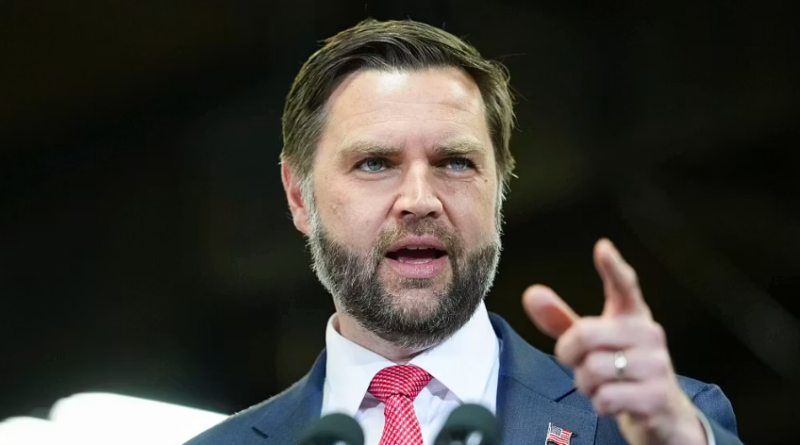
Vice President JD Vance delivered a blistering attack on Democratic Senate candidate Abdul El-Sayed Tuesday, accusing the Michigan politician of promoting racial division, embracing radical political figures and supporting policies that Vance argued would threaten the state’s automobile industry.
Speaking before departing for a campaign rally in Howell, Michigan, Vance described El-Sayed as a “little bit of a psychopath” while expressing his support for Republican Senate candidate Mike Rogers.
The vice president’s remarks came one week before the November 3 midterm elections, with the contest for Michigan’s open Senate seat attracting national attention.
Vance accused El-Sayed of associating with political commentators who have made controversial statements about the United States and questioned whether the Democrat’s positions reflect the priorities of Michigan residents.
The vice president also defended Rogers, a former FBI agent and congressman who previously chaired the House Intelligence Committee.
Vance’s criticism focused heavily on El-Sayed’s political associations, particularly his relationship with left-wing streamer Hasan Piker, who campaigned alongside the Democrat during the primary election.
Piker has faced criticism for previously declaring that America deserved the September 11 terrorist attacks, a statement he later described as poorly worded.
El-Sayed has also characterized Piker’s remarks as inappropriate, calling them “dumb.”
Nevertheless, Vance argued that El-Sayed’s willingness to associate with the commentator raised questions about his political judgment.
The vice president accused El-Sayed of promoting what he characterized as anti-white racial hostility, although he did not identify specific statements establishing that allegation.
Vance also criticized the Democratic candidate’s descriptions of his background and identity.
El-Sayed was born in Rochester Hills, Michigan, but has spoken publicly about his Egyptian heritage and family connections to North Africa.
During the Howell rally, Vance questioned statements in which El-Sayed had reportedly described himself as an immigrant from North Africa or an Egyptian citizen.
The vice president argued that the descriptions were inconsistent with El-Sayed’s Michigan birthplace and accused the candidate of misrepresenting his background.
The dispute became another point of contention in a Senate campaign already marked by disagreements over immigration, national identity and foreign policy.
Vance also attacked El-Sayed’s environmental agenda, arguing that policies associated with the Green New Deal would harm Michigan’s automobile manufacturers and their employees.
Michigan’s economy remains closely connected to vehicle production, making manufacturing policy a major issue in the Senate race.
Rogers has emphasized protecting automobile jobs and maintaining domestic manufacturing, while El-Sayed has promoted investments in clean energy and electric vehicles.
The candidates disagree over the economic consequences of those policies, particularly as manufacturers navigate changing consumer demand and federal trade regulations.
During Tuesday’s appearance, Vance warned that El-Sayed’s political approach could encourage the type of disorder recently seen during protests in France.
The vice president referenced unrest in Paris and suggested that El-Sayed and Piker would support similar demonstrations if they occurred in American cities.
He argued that the United States must defend its sovereignty and reject political movements that he believes undermine national unity.
Those remarks reflected Vance’s assessment of El-Sayed’s political views rather than evidence that the Democratic candidate has organized or endorsed violent demonstrations.
The vice president’s comments followed a Sunday campaign appearance by President Trump in Port Huron, Michigan, where the president also sharply criticized El-Sayed.
Trump accused the Democratic candidate of having extremist associations and used the term “jihadist” while discussing his candidacy.
Asked Tuesday whether he agreed with that description, Vance stopped short of adopting the president’s characterization.
Instead, he said El-Sayed had surrounded himself with controversial political figures and expressed concern about his judgment.
Vance acknowledged that he could not know the candidate’s personal beliefs or intentions.
The distinction came as El-Sayed responded to the Republican attacks by accusing Trump and his allies of focusing on his identity rather than the economic concerns of Michigan voters.
El-Sayed has argued that his campaign is centered on health care, affordability and improving economic opportunities for working families.
The Democrat has also criticized the Trump administration’s policies on tariffs, government spending and foreign affairs.
He has sought to frame the Republican attacks as distractions from those issues.
The Senate contest has become particularly important because Democratic Sen. Gary Peters is retiring, leaving the seat open for the first time in more than a decade.
Rogers previously represented Michigan in the House of Representatives and served as chairman of the House Intelligence Committee from 2011 to 2015.
He also worked as an FBI agent before entering Congress.
El-Sayed is a physician and former director of the Detroit Health Department who previously ran for Michigan governor in 2018.
Their campaign has featured substantial disagreements over immigration enforcement, economic policy, energy development and America’s relationship with Israel.
Vance’s appearance in Howell was part of a broader Republican campaign effort involving President Trump and several prominent Michigan candidates.
The vice president also promoted Republican gubernatorial candidate John James and Rep. Tom Barrett, emphasizing their support for the administration’s priorities.
Speaking to supporters at CHI Aviation, Vance argued that the midterm elections would determine whether the federal government continued advancing Trump’s economic and national security agenda.
He praised Rogers for his public service and said the Republican candidate possessed the experience necessary to represent Michigan in Washington.
The vice president also addressed criticism of Rogers from conservative commentator Tucker Carlson, who has questioned the former congressman’s foreign policy positions.
Vance defended Rogers as a fundamentally decent public servant and rejected the suggestion that those disagreements should overshadow the differences between the two Senate candidates.
The dispute illustrates divisions among conservatives over foreign policy, particularly America’s involvement overseas and its relationship with Israel.
Rogers has generally supported a strong American national security presence abroad, while Carlson has criticized interventionist policies and questioned longstanding foreign commitments.
Vance nevertheless emphasized his support for the Republican nominee during Tuesday’s campaign stop.
The vice president’s remarks also reflected the Trump administration’s broader focus on immigration, national sovereignty and domestic manufacturing.
Throughout the midterm campaign, Trump and Vance have argued that Republican policies prioritize American workers, border enforcement and public safety.
El-Sayed has challenged that message, accusing the administration of failing to address rising costs and other economic pressures.
Michigan voters will decide the Senate contest on November 3, alongside several other statewide and congressional races.
The latest confrontation demonstrates how sharply the campaign has intensified during its final week, with both parties bringing prominent national figures into Michigan.
For Vance, Tuesday’s visit provided an opportunity to defend Rogers’ record while challenging El-Sayed’s political positions and associations.
For El-Sayed, the attacks have created another opportunity to emphasize his economic agenda and dispute Republican descriptions of his beliefs.
With Election Day approaching, the candidates remain divided over the future of Michigan’s manufacturing economy, federal immigration policy and the country’s broader political direction.